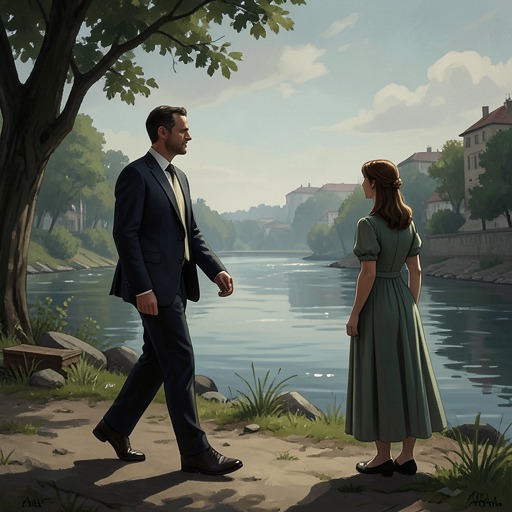
Haunting
The Death of Bunny MunroHaunting in the novel is the ambiguous persistence of Libby Munro after her death: her absence becomes a struggle in memory, a source of imagined comfort for Bunny Junior, and, for Bunny Munro, a presence he interprets as a reproachful return. These experiences do not settle whether Libby appears as a supernatural figure or through grief. Instead, they show two bereaved family members trying to remain connected to her in sharply different ways.
Memory and uncertainty
For Bunny Junior, haunting begins in the failure of memory. He can call up facts from his encyclopaedia with ease, but finds it increasingly difficult to remember what his mother looked like. To resist that loss, he arranges their shared experiences in his mind as if they were exhibits preserved behind glass. The method makes memories orderly, but cannot keep their central figure intact: in the recollection of Libby pushing him on a swing at St Ann’s Well Gardens, he can still see himself laughing in the air, while the person pushing him has dissolved into an incomplete image.
This vanishing leaves Bunny Junior imagining himself suspended above the ground, motherless and beyond human touch. The language of preservation and disappearance makes his haunting unlike a simple return of the dead: Libby is present as someone he struggles to picture, and absent even inside the memories meant to preserve her. A later sighting near the stairwell deepens the uncertainty. From the Punto, Bunny Junior sees a blonde woman in an Orange dressing gown, partly obscured by shadow, who disappears as she moves further into it. The scene does not establish who the woman is, but its appearance echoes the image of his mother that he is already afraid of losing.
Bunny Junior’s consoling visions
A later experience gives the boy’s longing a gentler form. Sitting in the Punto on Meeching Road in Newhaven, Bunny Junior thinks of a quasar and its extraordinary luminosity. He believes that if he stays in the car, his mother will eventually find him; he then senses her hand cream and touch, and hears a voice tell him that he is the most luminous object in the universe. The encounter joins his encyclopaedic knowledge to an intimate maternal image: an astronomical fact becomes the language through which he can feel addressed and cherished by Libby.
The fog scene develops that connection into an apparent reunion. Bunny Junior sees Libby in her Orange dressing gown, sitting on a low wall and beckoning him. He leaves the car, goes to her, apologizes, and rests his head against her. The scene presents contact as a temporary answer to the earlier image of himself left in the air, unable to descend or be touched. Yet it does not explain whether Libby has literally returned or whether the vision gives shape to the boy’s grief. What it makes clear is the emotional reality of the encounter for him: in that moment, she is truly his mother.
Bunny Munro’s interpretation
Bunny Munro’s experience is more troubled and self-accusing. During the crowd’s emotional response to his public plea, he sees Libby through the people around him and asks her forgiveness. He explains his past behaviour as having gone out of control and as having missed her intensely. The moment brings bereavement and remorse together: his appeal concerns not only the fact of her absence, but also the wrongs he associates with their marriage.
Bunny Munro asks whether her appearance means she will stop haunting him. Libby responds that she never haunted him, challenging the explanation he has given to her presence. His question, her denial, and her continued flickering appearance leave the matter unresolved. For Bunny Munro, the encounter has been a haunting; Libby refuses that account. The narrative supplies no separate confirmation that she has been returning to him, so the scene sustains a distinction between his experience and what can be known about its cause.
A continuing bond, not a settled explanation
The contrast between father and son gives haunting its particular force. Bunny Junior’s visions preserve a bond through comfort, memory, and a sense of being cared for. Bunny Munro’s vision is bound to grief and the need for forgiveness; he understands Libby’s appearance as a haunting, while she rejects that name. Neither experience simply resolves loss. The boy’s memories continue to fade even as he imagines reunion, and Bunny Munro’s apology does not make his question about Libby’s presence disappear.
The novel therefore leaves its supernatural possibility open without making uncertainty the same as emotional emptiness. Whether these appearances are visions or visits, Libby remains consequential to both father and son. Haunting names that continuing relation: not proof that grief can restore the dead, but a narrative form in which memory, longing, guilt, and imagined contact remain in conversation.